Some notes on TMK and the Academy
March 29, 2024•There's a lot of drama around TM Krishna (TMK hereon) this past week. I have refrained from consuming more than I need to know about what’s happening, so I may be missing some or even a lot of context. That’s okay because I am going to use the narratives around this incident as an opportunity to finally organize some of my thoughts around Carnatic music, EV Ramasamy, and the role of artiste in the public.
TMK has been conferred the Sangita Kalanidhi for 2024. Sangita Kalanidhi, given annually by the Madras Music Academy, is the preeminent award for Carnatic music. Tiruchur Brothers, Vishaka Hari, Dushyant Sridhar, Ranjani Gayatri, Chitravina Ravikiran (and maybe a few others) have declined to participate in the 2024 music season stating that they don’t want to share the stage with TMK. The response to this has been predictable. All the premier news papers and digital publications have accused the above of being closest casteists, elitist and so on. Why this particular line of accusation? Because TMK has a long history of making sweeping, abrasive statements to the effect that the Carnatic musicians and sabha culture are orthodox, hypocritical, and ill-willed towards others. This intersects with the larger popular discourse, especially in Tamil Nadu, that of the Brahmin as an irredeemable, scheming outsider. Unless one constantly apologies and renounces that identity, one is always suspect. N Ram, the brother of N Murali, the chief of Madras Music Academy, has this to say of Ranjani Gayatri's concerns: "...bigoted, casteist objections by a small coterie of set-up Carnatic musicians". N Murali, by the way, is a director of The Hindu Group.
TMK has the support of political powers that be. Kanimozhi, Lok Sabha MP, deputy general secretary of the DMK and the president of The Hindu and National Press Employees' Union came out with a statement. Her brother, the CM of Tamil Nadu Stalin, came out with another statement in TMK's favour and of course, insinuated that a certain community has a grudge. The state of discourse in Tamil Nadu is such that even bit players, who really should know better given their encounter with the Dravida Kazhagam political machine, toe the line. DMK, for those who can recall, very openly celebrated the total lack of representation of Brahmins - a minority - from the state assembly for the first time in the state's history, in 2021. Even their ideological counter parts in the center do not celebrate the absence of muslims from the parliament. Since politicians be politicking all the time, the BJP and AIADMK has gotten into the fray as well by commenting on the story.
I am going to attempt to answer some of the arguments I have encountered and make a case for why this dissent is really a principled stand. I am very much in sympathy with TMK’s project of bringing Carnatic music and high culture to everyone whatever their status. It cannot survive if it's limited to a few social classes. Carnatic music has to be made relevant in a world filled with dopamine-inducing distractions. However, he is not alone in doing it within the Carnatic music community, and his ways of doing it are unfair to his fellow artists. Moreover, TM Krishna LARPs as someone who speaks truth to power. He falls woefully short when calling out the pervasive Dravidian bigotry, or for that matter, even seeing it in the first place.1.
Does anyone wish to deny TMK the Sangita Kalanidhi?
The first objection is the easiest to get out of the way. No one feels TMK is untalented and undeserving of the Sangita Kalanidhi, if the award were really a signifier of excellence in the field. In their public notices, none of dissenters comment on the validity of conferring it on TMK. Their problem is that the awardee presides over a multi-week event, an event which is the highlight of the music calendar, and they do not wish to share the stage with him. TMK denigrates whatever they stand for and it would be awkward for them to interact with him.
Are these values they stand for casteist?
Most liberal commentators have concluded that since TMK is vocally anti-caste, RaGa and Dushyant Sridhar's dissent can be explained only by inherent casteism.
Well, are they? You should take their words and actions for it. RaGa, Chitravina Ravikiran, Tirchur Brothers all have students across caste lines. Dushyant Sridhar teaches Harikatha to anyone who comes to him, irrespective of caste. N Ravikiran has been in the social sphere for a long time, taking Carnatic music to various corners of Tamil Nadu, especially in spaces with no upper caste presence at all.
This particular charge has been laid on Carnatic music because some of its most famous practitioners are Brahmins. TMK's conclusion is that Carnatic musicians practice caste discrimination so that they can ensure their dominance and control over the art form. That the field has been studded with non-Brahmin greats doesn't matter (my personal favourites are U Srinivas and KJ Yesudas). TMK's other contention is that Brahmins have appropriated a non-Brahmin art form. To me that sounds as ridiculous as saying black basketball players have appropriated - taken something away from, illegitimately - white basketball players by dominating the scene. I like this basketball comparison because there's a clear majority in the field who are minorities in public life. To reduce the complexity of reasons for why things turned out the way they did to "bad Brahmins" shows, if you happen to be TMK2, a lack of complete engagement with truth. Not ignorance, but dishonesty.
There are plausible reasons that are capable of explaining the present moment, does not involve deception, and does not scapegoat any group. Public concert performances are a 20th-century phenomenon. Given the independence movement and dawn of representative democracy, patronage from kings and zamindars dropped. Modern occupations became attractive for a stable source of income. During this period non-Brahmin performers declined considerably. This transition happened alongside the systematic campaign of vilification against Brahmins and the Hindu religion, including art forms involving the two, by EV Ramasamy and Dravida Kazhagam. Around the same time, popular cinema and music took off, and these were monetarily more rewarding. Given the dominant trend of the day - the devaluing of classical music across the world - it is a suprise Carnatic music survived at all. That it did is because some Brahmins felt a cultural affinity towards it, and others could survive as full time musicians without having to depend on the music to make a living. There is no doubt that Music Academy had a significant role to play in its survival. Whatever the criticism about institutionalization of the arts, whether that of Bharatanatyam or Shastriya Sangeet, organization meant channeling of government funds, and the democratization of tools and spaces to appreciate it.
While this 20th century journey has made Carnatic music almost exclusively Hindu, it wasn't entirely that in the preceding 100 years. Vedanayagam Shastri was a contemporary of Tyagraja and spent time in the Tanjaore Court. He composed a lot of songs, almost all religious in nature, a reflection of his Protestant, Pietist faith. Abraham Pandithar traced the changing Carnatic music of his time and located its origins in the earliest Sangam poems. While Carnatic music can handle all expressions of faith3, it's Hindu variants cannot be divorced from Bhakti (contra TMK).
So that's where we are now: an art form was standardized. This happened as the world outside became non-Brahmin dominated culturally and politically. As it were, Brahmin identity and Carnatic music fused in India. At the same time, thanks to increasing indifference among non-Brahmins in general (as patrons of temple music, Periya Melam), non-Brahmins within the Carnatic music (nadasvaram vidwans, thavil vidwans etc) tradition came to depend economically and artistically on Brahmin patrons, a complete inverse of the relationship between the two at the start of the 20th century. As a result, music production, documentation and cultural history acquired a distinct Brahmin bias.
Why announce the withdrawal in public?
Why not wait for a response from the organizers? Artistes, public performers, are role models. What they say or do matters. If you rise up in life you have a moral duty to be an exemplar. You must set an example. By taking a public stance, they are only doing one of their duties as custodians of a tradition.
Related to this theme, MS Subbulakshmi's great grandson says "..She[MSS] does not need spokespersons or superficial custodians of her legacy to use her name and score personal brownie points." I disagree. MSS was/is a public figure of great import, and once you are a public figure you are going to be used to prop one position or the other. So when TMK uses her to make a point about Sabha culture, she will be used to make the opposite point. MSS's progeny have as much say in the matter as anybody, but not more. Sticking with analogies, can the custodian of Nehru's legacy be only Rahul Gandhi? Can only Gopalkrishna Gandhi talk about Gandhi or Rajaji? Carnatic music and its greats, like modern India, is a shared inheritance.
What has EV Ramasamy got to do with anything?
I would argue it’s got everything to do with it! EV Ramasamy was a prickly rabble rouser who is central to the Dravidian project. The Dravidian movement invests in his figure everything that is good and modern - equality, self-respect, rejection of the gods, liberation of women. He could have been all that in his better moments, but for the last 50 years of his life he was a raging anti-Brahmin, and incidentally, an anti-semite. He compared the Brahmins to the Jews and wished to do to them what Hitler was doing in Germany. E.V. Ramasamy wrote this in his magazine Kudiyarasu on March 20, 19384:
“The Jews are only interested in themselves, and nobody else. They somehow contrive to have the rulers in their pocket, participate in governance and conspire to torture and suck the lives out of other citizens in order that they live (in comfort). Are they not comparable to the Brahmins who too have no responsibility but have the rulers in their pocket, have entered the ruling dispensation and been lording over (all of us)?”
This is also the position of the Dravidian movement in general. CN Annadurai echoed those same talking points in 1950s, after the full extent of the horrors inflicted by the Nazis became clear5. EV Ramasamy, through his career, has called for his fellow Tamils to kill Brahmins around them many times. Here’s one instance, in Karaikudi in 1971, after the Dravida Kazhagam win over K. Kamaraj.
His modern day supporters know what they are talking about, and it's not social justice.
Jawaharlal Nehru sent a letter to Kamaraj, the then CM of Madras State, calling EVR a madman.
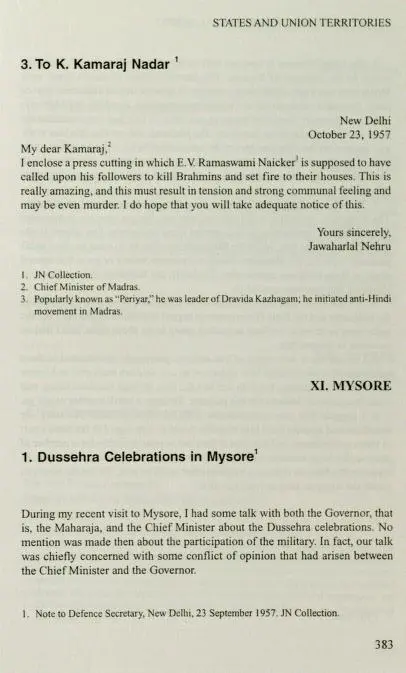
And again on Nov 5, 19576:
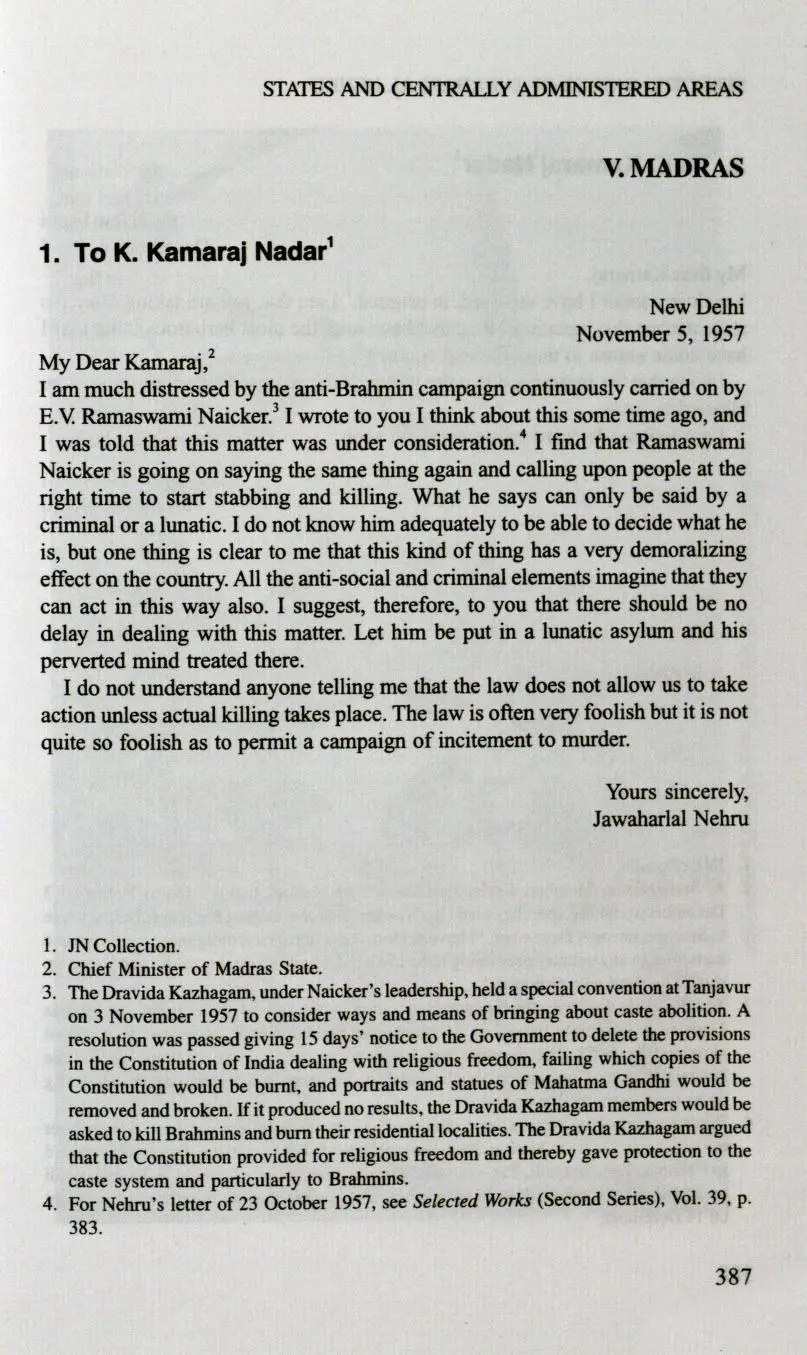
An year before this, EVR was arrested for burning pictures of Lord Rama on the Marina Beach7. In the 1960s, he asked Tamils to start using caste names because it was getting harder to identify Brahmins, presumably to harass and intimidate.
EVR and Justice Party resolved that parts of South India should be a separate country and the ideology underlying this country, Dravida Nadu, was pure racism. North Indians are a alien race and Brahmins are intruders and possibly Jews. Later, when India attained independence EVR boycotted the day.
This anti-democratic8, vulgar, prejudiced man is who TMK celebrates as having taught Tamils to think. Let's briefly note the condescension on display here. TMK seems to agree with EVR that two thousand years of Tamil literature and heritage are worthless. EVR called Silappadikaram, the great Tamil epic written by Ilango Adigal, an Aryan propaganda tool. He considered Thirukkural as “feces placed in a golden plate”. He thought the Tamils an unintelligible people for valuing Kamba Ramayanam and Silappadikaram. Even the other Tamil Nationalists have wisened up to the DK project (to be clear, I do not approve of ethno-nationalists of any kind).
The Justice Party and Dravidian Movement has always been about Non-Brahmin elites masquerading as subaltern. They took the brief period under the British colonialism where Brahmins ended up staffing most of the bureaucracy as a testament of a permanent Brahmin hegemony and projected it into the past. The viciousness of their discourse, even now, after the elimination of the Brahmins from TN politics, state bureaucracy, and education, yet daily inter-caste violence, ought to make any liberal to dig deep into their claims about social justice and the false dichotomy of a monolithic non-Brahmin front versus the Brahmins.
RaGa are brave in taking their stance when they know it will bring upon them the ire of the entire political establishment. TM Krishna, quite rightly, is critical about BJP and Hindutva for its authoritarian tendencies and a politics that thrives on divisions. Dravida Kazhagam and the EVR are exactly the same, illiberal, authoritarian, and divisive, except their bogeyman happens to be Brahmins. His willful blindness in not just accommodating, but also pushing Dravida Kazhagam talking points, is hypocritical. Is it because unlike Hindutva folks, the Dravidians strut about as inclusive and progressive? Does North Korea calling itself a democratic people's republic make it one?
Okay, ignore the political stuff, the award has nothing to do with it. It's all about the music.
Maybe so, but the citation does say "...he has used music as a tool for social reform" and "..his championing of social causes". He refused to participate in the music season for 10 years, and now he is back, a little over one year after Stalin inaugurated the 2022 festival. TMK himself has said he believes everything is politics. We will be charitable, and take N Murali at his word. Without a doubt TMK is richly deserving of this and many such awards.
The real question is how does one separate the art from the artist? TMK is capable of bringing the most aloof of his audiences, if they are even slightly sensitive to the arts, to a state of ecstasy. Despite all the peacocking and sanctimony, that's valuable, surely? The highest value Steve Jobs had was beauty. He thought the best one can do for one's fellow human being was to create something beautiful. He imbued everything he did with this attitude, always at exacting standards. His legacy is evident. He was also an ass to everyone around him and those who worked for him. Oscar Wilde is a revered figure now, an embodiment of wit. His Importance of Being Earnest is a popular school play. He also slept with male prostitutes and teenage boys. Vairamuthu is an acclaimed poet, must admired by his peers. He is also a serial molester. Erza Pound was a Nazi9 sympathizer. The list of problematic artists is never ending - Kanye West, Paul Gaugin, Drake to name just a few.
The answer to the question, I suppose, is up to the consumer of the image thus being constructed. The boundary of acceptable behaviour changes over time and culture10. I cannot in good conscience be a patron of TM Krishna, but I can understand if others are.
The current DMK dispensation comes down heavily on anyone who dares to question them or their heroes, sometimes under unrelated charges. While I disagree with some of their words11, right now I am firmly behind Ranjani Gayatri and hope they come out of this unscathed. Ranjani Gayatri have said what they hope to do with their art is unite people. Here's to them succeeding beyond their wildest dreams.
FOOTNOTES